Researchers developed a compact, lightweight depth sensor inspired by the eyes of jumping spiders, which use minimal computation for depth perception while navigating and snagging prey; the depth sensor, which combines multifunctional metalenses, ultrathin nanophotonic parts, and an optimized image processing algorithm, requires less computation than previous passive artificial depth sensors, and paves the way for the future incorporation of depth sensing ability into microrobots, microsensor networks, and ingestible and wearable devices, according to the authors.
Article #19-12154: "Compact single-shot metalens depth sensors inspired by eyes of jumping spiders," by Qi Guo et al.
MEDIA CONTACT: Zhujun Shi, Harvard University, Cambridge, MA; e-mail: zhujunshi@g.harvard.edu ; Federico Capasso, Harvard University, Cambridge, MA; e-mail: capasso@seas.harvard.edu
###
Proceedings of the National Academy of Sciences
Additional Media
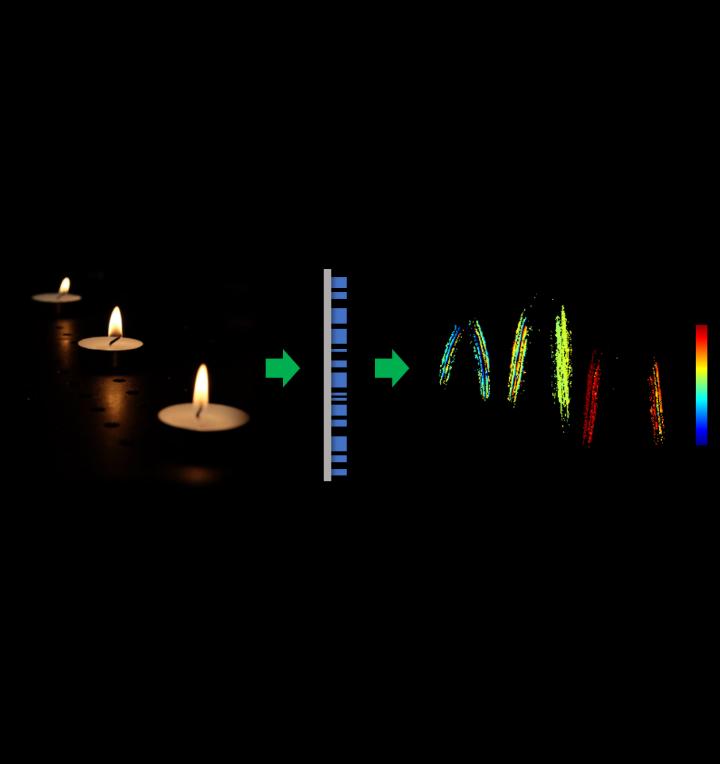
Compact single-shot depth sensors enabled by nanostructured flat lenses (i.e. metalenses). The flat lens (shown in the middle) captures images of a 3D scene, for example candle flames placed at different locations (left), and produces a depth map (right) using a computer vision algorithm inspired by the eye of jumping spiders. The color on the depth map represents object distance. The closer and farther objects are colored red and blue respectively. Credit: Image courtesy of Qi Guo and Zhujun Shi.
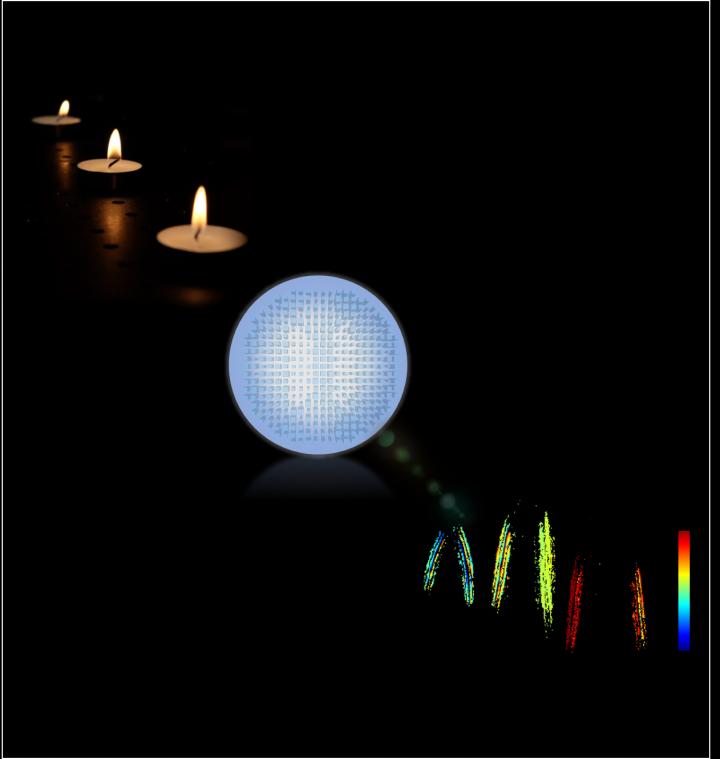
Compact single-shot depth sensors enabled by nanostructured flat lenses (i.e. metalenses). The flat lens (shown in the middle) captures images of a 3D scene, for example candle flames placed at different locations (left), and produces a depth map (right) using a computer vision algorithm inspired by the eye of jumping spiders. The color on the depth map represents object distance. The closer and farther objects are colored red and blue respectively. Credit: Image courtesy of Qi Guo and Zhujun Shi.
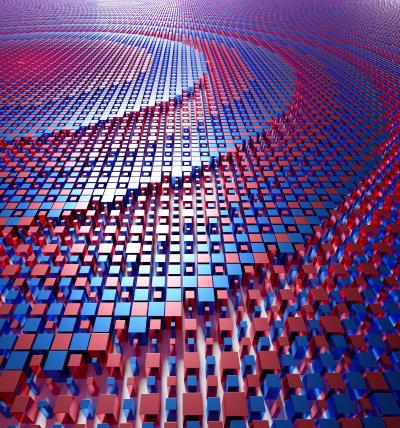
Visualization of a metalens designed for compact depth sensing. It consists of subwavelength-spaced square nanopillars. By alternating two different nanopillar patterns, visualized here in red and blue, this metalens forms two images at the same time. The two images have different amounts of defocus, and they mimic the images captured by the layered retina structure in the principal eyes of jumping spiders. Credit: Image courtesy of Qi Guo and Zhujun Shi