Researchers from PKU, CAEP, SJTU, and UESTC have unveiled findings on the generation and regulation of electromagnetic pulses (EMPs) produced by multi-petawatt lasers interacting with nitrogen gas jets. Published in a comprehensive study, their work demonstrates how EMP characteristics can be tuned by adjusting laser energy and gas jet pressure, paving the way for controlled EMP applications in scientific and industrial fields.
Key Findings and Innovations
The study reveals that EMP intensity is directly correlated with the quantity and energy of electrons accelerated by the plasma channel formed during laser-gas jet interactions. By varying nitrogen gas jet pressure (1–3.15 MPa) and laser energy (16–48 J), the team observed peak EMP amplitude at 2.15 MPa, beyond which intensity declined due to energy loss in plasma channel boundaries.
Notably, the research identifies four primary EMP sources:
Implications for Industry and Research
The ability to control EMPs through laser and gas jet parameters holds promise for:
The complete study is accessible via DOI: 10.1007/s41365-025-01692-6
Nuclear Science and Techniques
10.1007/s41365-025-01692-6
Experimental study
Not applicable
Generation and regulation of electromagnetic pulses induced by multi-petawatt laser coupling with gas jets
19-Apr-2025
Additional Media
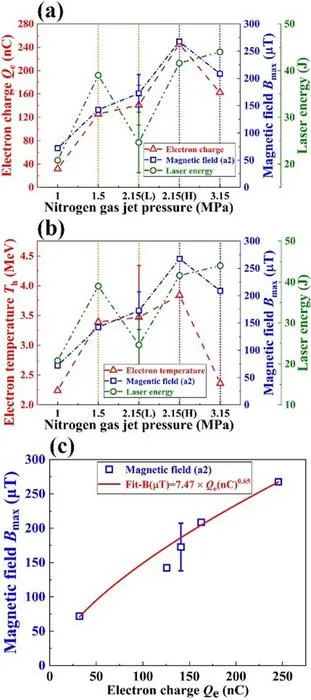
Experimental measurements demonstrate the relationship between electron charge, temperature, and EMP intensity as nitrogen gas jet pressure varies, which identifies that the variation in accelerated electron dynamics induced by laser energy and gas pressure constitutes a critical factor governing the intensity and distribution of electromagnetic pulses (EMPs). Credit: Zhi-Gang Deng
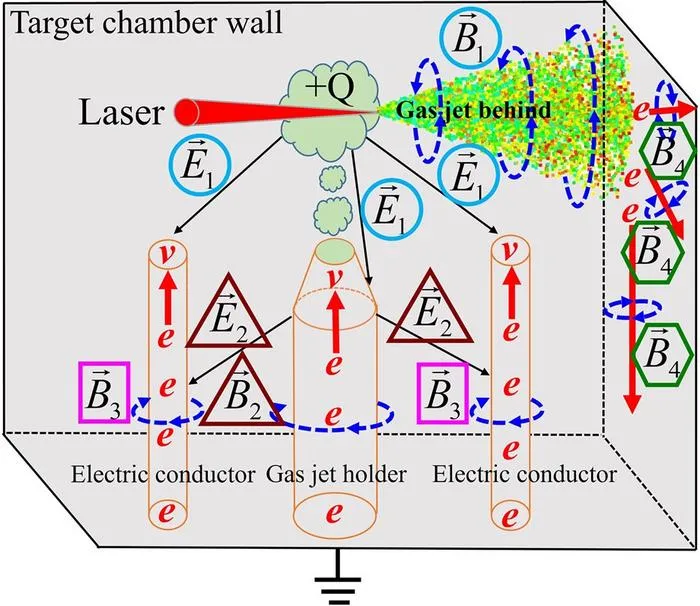
This schematic summarizes four primary EMP sources identified in the study:Transient Currents from Escaping Electrons:Electrons accelerated by the laser generate time-varying currents, emitting EMPs along their trajectory.Neutralization Currents:The positively charged gas target induces currents through the conductive holder, radiating EMPs.Induced Currents on Chamber Conductors:EMPs from sources (1) and (2) excite surface currents on nearby metallic structures.Electron-Wall Collisions:Electrons Credit: Zhi-Gang Deng
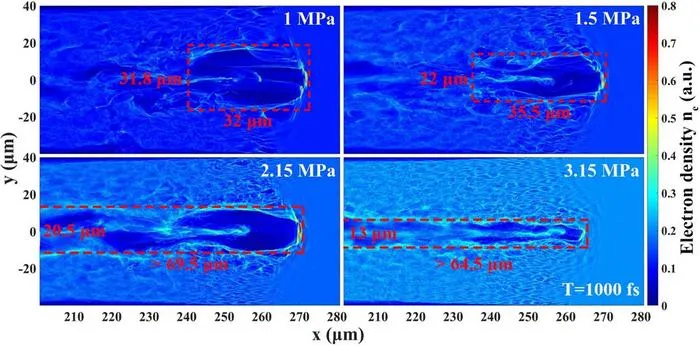
To further reveal the physical processes of petawatt laser ablation on nitrogen gas jets, based on the 2D PIC software EPOCH. Simulations show how plasma channel structures evolve under different gas jet pressures, affecting the self-focusing and acceleration of electrons. 2D simulations reveal plasma channel elongation at 2.15 MPa, maximizing electron trapping and acceleration. At 3.15 MPa, channel contraction due to defocusing reduces electron yield. Credit: Zhi-Gang Deng