Four winners have been selected in the 2025 Faces of Biology Photo Contest , sponsored by the American Institute of Biological Sciences (AIBS) and the Society for Integrative and Comparative Biology (SICB).
"The contest winners this year illuminate biological field research, from the humid wetlands to the vast savannas." said Scott Glisson, CEO of AIBS. "By capturing scientists in the field, these powerful images serve as essential documentation, making the dedication and diversity of their scientific endeavor visible to the world."
The competition highlights biological research through impactful, personal imagery, illustrating its diverse forms and settings. By showcasing these visuals, it aims to help the public and policymakers recognize the importance of biological research and education.
A forthcoming issue of the journal BioScience will feature the first-place photograph on the cover and the second- and third-place photos in an article. All of the winners receive a one-year subscription to BioScience . Heather Frantz, the first-place winner, will also receive $250.
Additional Media
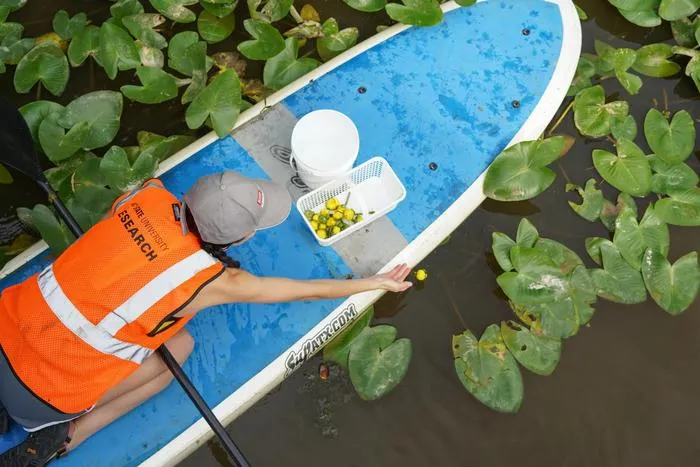
Heather Frantz, from North Carolina State University, won first place. In this photograph, graduate student April Sharp reaches for a Spatterdock water lily (Nuphar advena) flower from a paddleboard on Yates Millpond. Her work is essential for advancing our knowledge of how pollen's medicinal properties function. Credit: Heather Frantz
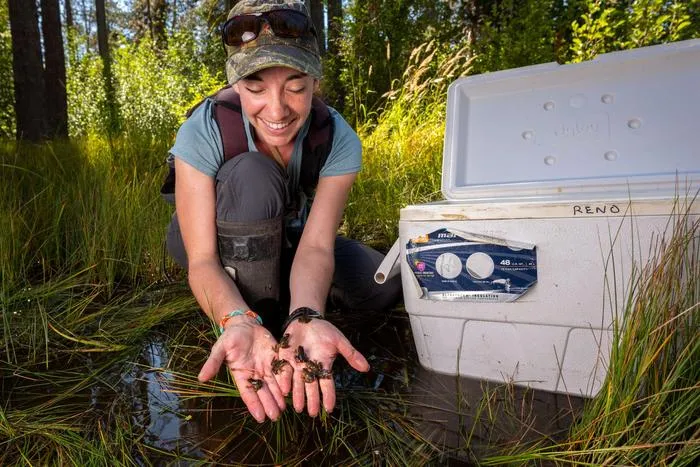
Ryan Wagner, from Washington State University, also won second place for this photograph of Kate Belleville releasing a handful of froglets into a California wet meadow after a week of disease treatments. Froglets were captured and treated with an antifungal solution to combat the deadly chytrid fungus. This treatment significantly raises survival rates, aiding the restoration of declining populations. Credit: Ryan Wagner
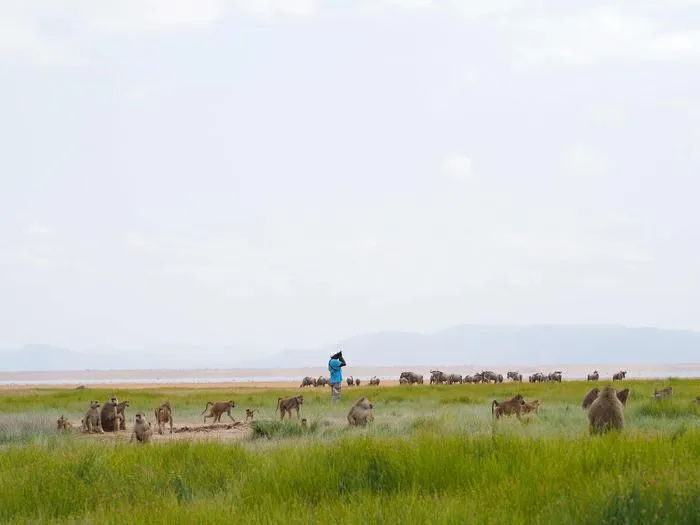
Third place went to Susan Alberts of Duke University for this photograph of Kinyua Warutere observing baboons in the Amboseli basin of southern Kenya. Kinyua, a senior observer with the Amboseli Baboon Research Project, has been studying the baboons since 1995 and is surrounded by his study animals at a waterhole, with wildebeest in the background. Credit: Susan Alberts.